Volatility Forecasts (Part 5 — PGARCH)

2026-03-10

1 Introduction

In Part 4 we found that in our rather limited SPY variance forecasting benchmark, GARCH(1,1) dominated the STES family under out-of-sample QLIKE even though the STES variants had more flexible predictor-driven gates. That result suggested that the real advantage for GARCH(1,1) was perhaps structural. GARCH separates an anchor, a persistence term, and a shock-transmission term, whereas STES-family has only a shock-transmission term, albeit a dynamic one. The question now is whether we can generalize GARCH(1,1) to use predictor-driven gate, and if this will deliver better results.

A natural first generalization is the unrestricted three-feature PGARCH specification in which all three channels–the anchor, persistence, and shock-transmission term–or (\mu_t, \phi_t, g_t), vary with lagged return information. Those unrestricted models remain useful comparison points in this post. We keep our information set to the same ones we used in Part 4: lagged return, lagged absolute return, and lagged squared return. Those are all fast shock-sensitive features. They are plausible drivers of short-run persistence and shock loading, but they do not give a clean basis for a time-varying long-run variance channel. Therefore we also test other variants in which we keep the anchor a constant, for example.

This post keeps the dataset, target definition, train/test split, QLIKE evaluation, DM-test protocol, and GARCH(1,1) benchmark fixed. We want to determine if the same information set supports a time-varying or constant long-run anchor with time-varying persistence and time-varying shock loading.

The implementation for the models discussed within this post can be found in the volatility-forecast package: the linear restrictions are in volatility_forecast/model/pgarch_linear_model.py, and the boosted g extension remains in volatility_forecast/model/xgb_pgarch_model.py. The discussion here uses that code under the fixed SPY split and the same QLIKE/DM protocol from Part 4.

2 Three-Feature PGARCH Setup

We first reparametrize GARCH(1,1) into a more interpretable form: writing out GARCH(1,1)

h_t = \omega + \alpha y_{t-1} + \beta h_{t-1}, \quad y_{t-1} = r_{t-1}^2

and let

\phi = \alpha + \beta, \quad g = \frac{\alpha}{\alpha + \beta}, \quad \mu = \frac{\omega}{1 - \alpha - \beta}

we can rewrite the GARCH(1,1) recursion as

h_t = (1-\phi)\mu + \phi q_t, \quad q_t = g y_{t-1} + (1-g) h_{t-1}

where \mu is interpreted as the the long-run variance anchor, \phi is persistence, and g is the shock transmission weight inside the persistent component. When fitting GARCH(1,1) we typically impose the constraints

\omega > 0, \quad \alpha \ge 0, \quad \beta \ge 0, \quad \alpha + \beta < 1,

which imply

\mu > 0, \quad 0 \le \phi \le 1, \quad 0 \le g \le 1,

We generalize the reparameterized GARCH(1,1) by setting \mu, \phi, and g as dependent on exogenous variables. The unrestricted PGARCH recursion is

h_t = (1-\phi_t)\mu_t + \phi_t q_t, \qquad q_t = g_t y_{t-1} + (1-g_t) h_{t-1}

Here h_t is our one-step-ahead conditional variance forecast. The training target remains the next-day squared return, y_t = r_t^2, on the same SPY sample and the same train/test split used in Part 4. The predictor vector is the original three-feature return design

x_{t-1} = \left(r_{t-1}, |r_{t-1}|, r_{t-1}^2\right)

With \mu_t > 0, \phi_t \in (0,1), and g_t \in (0,1), we might even declare that \mu_t is the anchor, \phi_t governs persistence, and g_t controls how strongly the next-step forecast reacts to the most recent shock relative to the previous state. This, however, is not guaranteed to be the case.

3 Dynamic \mu_t and the Three-Feature Design

The unrestricted PGARCH recursion is a coherent forecasting specification, but its interpretation depends on what the predictors can represent. In this three-feature setting the predictors are all immediate return transforms. They react quickly to shocks and volatility bursts. None of them is a slow state variable, a realized-volatility window, a market-level regime proxy, or a macro indicator. Asking those same fast signals to identify a time-varying long-run anchor \mu_t therefore creates a structural ambiguity: the model may achieve acceptable fit by pushing short-run information into a channel that is supposed to describe the long-run variance level.

If we want to interpret \mu as the slow-moving long-run variance, we cannot explain it using fast-moving daily return variables. Given our feature set, we should hold the anchor fixed and let only the short-run channels adapt:

h_t = (1-\phi_t)\mu + \phi_t\Big(g_t y_{t-1} + (1-g_t) h_{t-1}\Big)

In this form the interpretation of a channel is “constrained” by construction. The scalar \mu is the constant long-run anchor. The sequence \phi_t is time-varying persistence. The sequence g_t is time-varying shock loading. This can be the more interpretable specification for PGARCH in our setting. It uses the fast return features where they are most naturally informative and stops asking them to identify a separate long-run variance process.

Here “constant” means that \mu is estimated as a single scalar parameter over the sample rather than updated from the three return-based predictors at each date. The restriction is about time variation, not about treating the long-run variance level as known in advance.

4 Model Definitions

We adopt a more explicit naming convention in the tables and figures. The bracketed suffix states which channels are dynamic and which are held fixed. For example, PGARCH-L[mu,phi,g dyn] means that all three channels are dynamic, while PGARCH-L[mu const; phi,g dyn] means that the long-run anchor is constant and only the persistence and shock-loading channels vary over time.

With that convention, the two unrestricted baseline specifications are PGARCH-L[mu,phi,g dyn] and XGB-g-PGARCH[mu,phi,g dyn]. The constant-\mu family is PGARCH-L[mu const; phi,g dyn], XGB-g-PGARCH[mu const; phi,g dyn], PGARCH-L[mu,phi const; g dyn], and the diagnostic PGARCH-L[mu,g const; phi dyn].

The unrestricted models remain useful comparison specifications. The constant-\mu models provide the cleaner structural interpretation for this three-feature setting. After first mention, we refer to these in running prose as the unrestricted linear model, the unrestricted boosted-g model, the constant-\mu linear model, the constant-\mu boosted-g model, the g-only restriction, and the \phi-only restriction.

5 Core Results

Fit the fixed-split GARCH(1,1) benchmark used throughout Part 5
r_tr_pct = r_tr * SCALE_FACTOR
r_all_pct = pd.concat([r_tr, r_te]) * SCALE_FACTOR

garch_spec = arch_model(r_tr_pct, vol="GARCH", p=1, q=1, mean="Zero", rescale=False)
garch_fit = garch_spec.fit(disp="off")
omega_g = garch_fit.params["omega"]
alpha_g = garch_fit.params["alpha[1]"]
beta_g = garch_fit.params["beta[1]"]

garch_spec_full = arch_model(r_all_pct, vol="GARCH", p=1, q=1, mean="Zero", rescale=False)
garch_fit_full = garch_spec_full.fit(disp="off", last_obs=len(r_tr))
garch_fcast = garch_fit_full.forecast(start=len(r_tr), reindex=False)
garch_pred_os = garch_fcast.variance.values.flatten() / (SCALE_FACTOR ** 2)

print(
    "GARCH(1,1) benchmark on the ARCH percent-return scale: "
    f"omega={omega_g:.6f}, alpha={alpha_g:.4f}, beta={beta_g:.4f}"
)
GARCH(1,1) benchmark on the ARCH percent-return scale: omega=0.018841, alpha=0.0952, beta=0.8899
Fit the unrestricted and constant-mu PGARCH variants under QLIKE
# Historical unrestricted Part 5 baselines
pgarch_l_qlike = PGARCHLinearModel(loss="qlike", random_state=42)
pgarch_l_qlike.fit(y_tr.values, X_pgarch_tr.values)
pgarch_l_qlike_os = pgarch_l_qlike.predict_variance(y_all.values, X_pgarch_all.values)[len(y_tr):]

y_tr_pgarch_scaled = y_tr.values * (SCALE_FACTOR ** 2)
y_all_pgarch_scaled = y_all.values * (SCALE_FACTOR ** 2)

xgb_pgarch_qlike = XGBGPGARCHModel(
    booster="gblinear",
    loss="qlike",
    n_estimators=200,
    learning_rate=0.05,
    max_depth=3,
    min_child_weight=5.0,
    reg_lambda=0.01,
    init_method="linear_pgarch",
    random_state=42,
)
xgb_pgarch_qlike.fit(y_tr_pgarch_scaled, X_pgarch_tr)
xgb_pgarch_qlike_os = xgb_pgarch_qlike.predict_variance(
    y_all_pgarch_scaled,
    X_pgarch_all,
) / (SCALE_FACTOR ** 2)
xgb_pgarch_qlike_os = xgb_pgarch_qlike_os[len(y_tr):]

# Structurally disciplined constant-mu family
pgarch_l_constmu_qlike = PGARCHLinearModel(
    loss="qlike",
    dynamic_mu=False,
    dynamic_phi=True,
    dynamic_g=True,
    random_state=42,
)
pgarch_l_constmu_qlike.fit(y_tr.values, X_pgarch_tr.values)
pgarch_l_constmu_qlike_os = pgarch_l_constmu_qlike.predict_variance(
    y_all.values,
    X_pgarch_all.values,
)[len(y_tr):]

pgarch_g_constmu_qlike = PGARCHLinearModel(
    loss="qlike",
    dynamic_mu=False,
    dynamic_phi=False,
    dynamic_g=True,
    random_state=42,
)
pgarch_g_constmu_qlike.fit(y_tr.values, X_pgarch_tr.values)
pgarch_g_constmu_qlike_os = pgarch_g_constmu_qlike.predict_variance(
    y_all.values,
    X_pgarch_all.values,
)[len(y_tr):]

pgarch_phi_constmu_qlike = PGARCHLinearModel(
    loss="qlike",
    dynamic_mu=False,
    dynamic_phi=True,
    dynamic_g=False,
    random_state=42,
)
pgarch_phi_constmu_qlike.fit(y_tr.values, X_pgarch_tr.values)
pgarch_phi_constmu_qlike_os = pgarch_phi_constmu_qlike.predict_variance(
    y_all.values,
    X_pgarch_all.values,
)[len(y_tr):]

xgb_pgarch_constmu_qlike = XGBGPGARCHModel(
    booster="gblinear",
    loss="qlike",
    n_estimators=200,
    learning_rate=0.05,
    max_depth=3,
    min_child_weight=5.0,
    reg_lambda=0.01,
    init_model=PGARCHLinearModel(
        loss="qlike",
        dynamic_mu=False,
        dynamic_phi=True,
        dynamic_g=True,
        random_state=42,
    ),
    random_state=42,
)
xgb_pgarch_constmu_qlike.fit(y_tr_pgarch_scaled, X_pgarch_tr)
xgb_pgarch_constmu_qlike_os = xgb_pgarch_constmu_qlike.predict_variance(
    y_all_pgarch_scaled,
    X_pgarch_all,
) / (SCALE_FACTOR ** 2)
xgb_pgarch_constmu_qlike_os = xgb_pgarch_constmu_qlike_os[len(y_tr):]

actual_os = y_te.values
core_model_predictions = {
    "GARCH(1,1)": garch_pred_os,
    "PGARCH-L[mu,phi,g dyn]": pgarch_l_qlike_os,
    "XGB-g-PGARCH[mu,phi,g dyn]": xgb_pgarch_qlike_os,
    "PGARCH-L[mu const; phi,g dyn]": pgarch_l_constmu_qlike_os,
    "XGB-g-PGARCH[mu const; phi,g dyn]": xgb_pgarch_constmu_qlike_os,
    "PGARCH-L[mu,phi const; g dyn]": pgarch_g_constmu_qlike_os,
    "PGARCH-L[mu,g const; phi dyn]": pgarch_phi_constmu_qlike_os,
}

linear_structural_models = {
    "PGARCH-L[mu,phi,g dyn]": pgarch_l_qlike,
    "PGARCH-L[mu const; phi,g dyn]": pgarch_l_constmu_qlike,
    "PGARCH-L[mu,phi const; g dyn]": pgarch_g_constmu_qlike,
    "PGARCH-L[mu,g const; phi dyn]": pgarch_phi_constmu_qlike,
}

print("Core Part 5 PGARCH variants fitted under the fixed three-feature protocol.")
Core Part 5 PGARCH variants fitted under the fixed three-feature protocol.
Code
def _qlike_loss(y, yhat, eps=1e-8):
    y = np.asarray(y, dtype=float)
    yhat = np.clip(np.asarray(yhat, dtype=float), eps, None)
    ratio = np.clip(y, eps, None) / yhat
    return ratio - np.log(ratio) - 1.0


evidence_labels = {
    "GARCH(1,1)": "benchmark",
    "PGARCH-L[mu,phi,g dyn]": "directional improvement",
    "XGB-g-PGARCH[mu,phi,g dyn]": "similar to benchmark",
    "PGARCH-L[mu const; phi,g dyn]": "directional improvement",
    "XGB-g-PGARCH[mu const; phi,g dyn]": "directional improvement",
    "PGARCH-L[mu,phi const; g dyn]": "weaker on this split",
    "PGARCH-L[mu,g const; phi dyn]": "directional improvement",
}

role_labels = {
    "GARCH(1,1)": "benchmark",
    "PGARCH-L[mu,phi,g dyn]": "comparison specification",
    "XGB-g-PGARCH[mu,phi,g dyn]": "boosted comparison",
    "PGARCH-L[mu const; phi,g dyn]": "main structural specification",
    "XGB-g-PGARCH[mu const; phi,g dyn]": "boosted comparison",
    "PGARCH-L[mu,phi const; g dyn]": "diagnostic restriction",
    "PGARCH-L[mu,g const; phi dyn]": "diagnostic restriction",
}

story_order = [
    "GARCH(1,1)",
    "PGARCH-L[mu,phi,g dyn]",
    "XGB-g-PGARCH[mu,phi,g dyn]",
    "PGARCH-L[mu const; phi,g dyn]",
    "XGB-g-PGARCH[mu const; phi,g dyn]",
    "PGARCH-L[mu,phi const; g dyn]",
    "PGARCH-L[mu,g const; phi dyn]",
]


core_rows = []
for name in story_order:
    pred = core_model_predictions[name]
    dm_stat = np.nan
    p_value = np.nan
    if name != "GARCH(1,1)":
        dm = diebold_mariano(
            _qlike_loss(actual_os, pred),
            _qlike_loss(actual_os, garch_pred_os),
            h=1,
        )
        dm_stat = dm["dm_stat"]
        p_value = dm["p_value"]

    core_rows.append(
        {
            "Model": name,
            "OS RMSE": rmse(actual_os, pred),
            "OS QLIKE": qlike(actual_os, pred),
            "DM vs GARCH": dm_stat,
            "p vs GARCH": p_value,
            "Evidence": evidence_labels[name],
            "Role": role_labels[name],
        }
    )

core_summary_table = pd.DataFrame(core_rows)
display(style_results_table(core_summary_table, precision=6, index_col="Model"))
Core Part 5 comparison on the fixed three-feature protocol
  OS RMSE OS QLIKE DM vs GARCH p vs GARCH Evidence Role
Model            
GARCH(1,1) 0.000460 1.561044 nan nan benchmark benchmark
PGARCH-L[mu,phi,g dyn] 0.000459 1.550092 -0.422467 0.672729 directional improvement comparison specification
XGB-g-PGARCH[mu,phi,g dyn] 0.000468 1.558925 -0.086575 0.931018 similar to benchmark boosted comparison
PGARCH-L[mu const; phi,g dyn] 0.000448 1.545357 -1.364132 0.172677 directional improvement main structural specification
XGB-g-PGARCH[mu const; phi,g dyn] 0.000447 1.545519 -1.352483 0.176371 directional improvement boosted comparison
PGARCH-L[mu,phi const; g dyn] 0.000479 1.562354 0.173305 0.862429 weaker on this split diagnostic restriction
PGARCH-L[mu,g const; phi dyn] 0.000459 1.544160 -2.624103 0.008753 directional improvement diagnostic restriction

QLIKE and the DM test remain the primary comparison tools in Part 5. RMSE is reported as a secondary scale diagnostic. The Evidence and Role columns summarize, respectively, the forecast evidence on this split and the reason each specification appears in the comparison.

Focused ranking chart for the core Part 5 models
core_palette = {
    "GARCH(1,1)": "#5F7A8A",
    "PGARCH-L[mu,phi,g dyn]": "#17614E",
    "XGB-g-PGARCH[mu,phi,g dyn]": "#3AAFA9",
    "PGARCH-L[mu const; phi,g dyn]": "#C46B2D",
    "XGB-g-PGARCH[mu const; phi,g dyn]": "#E08D3C",
    "PGARCH-L[mu,phi const; g dyn]": "#B24C63",
    "PGARCH-L[mu,g const; phi dyn]": "#7A8F3A",
}

fig, axes = plt.subplots(1, 2, figsize=(14, 8))

for ax, metric in zip(axes, ["OS RMSE", "OS QLIKE"]):
    chart_df = core_summary_table.sort_values(metric, ascending=True).reset_index(drop=True)
    colors = [core_palette.get(model, "#999999") for model in chart_df["Model"]]
    bars = ax.barh(chart_df["Model"], chart_df[metric], color=colors, edgecolor="white", linewidth=0.6)
    ax.set_title(metric, fontsize=12, fontweight="bold")
    ax.set_xlabel(metric)
    ax.invert_yaxis()
    for bar, value in zip(bars, chart_df[metric]):
        ax.text(value, bar.get_y() + bar.get_height() / 2, f" {value:.6f}", va="center", fontsize=7)

fig.suptitle("Core Part 5 Comparison: Unrestricted vs Constant-mu PGARCH", fontsize=13, fontweight="bold")
fig.tight_layout()
plt.show()

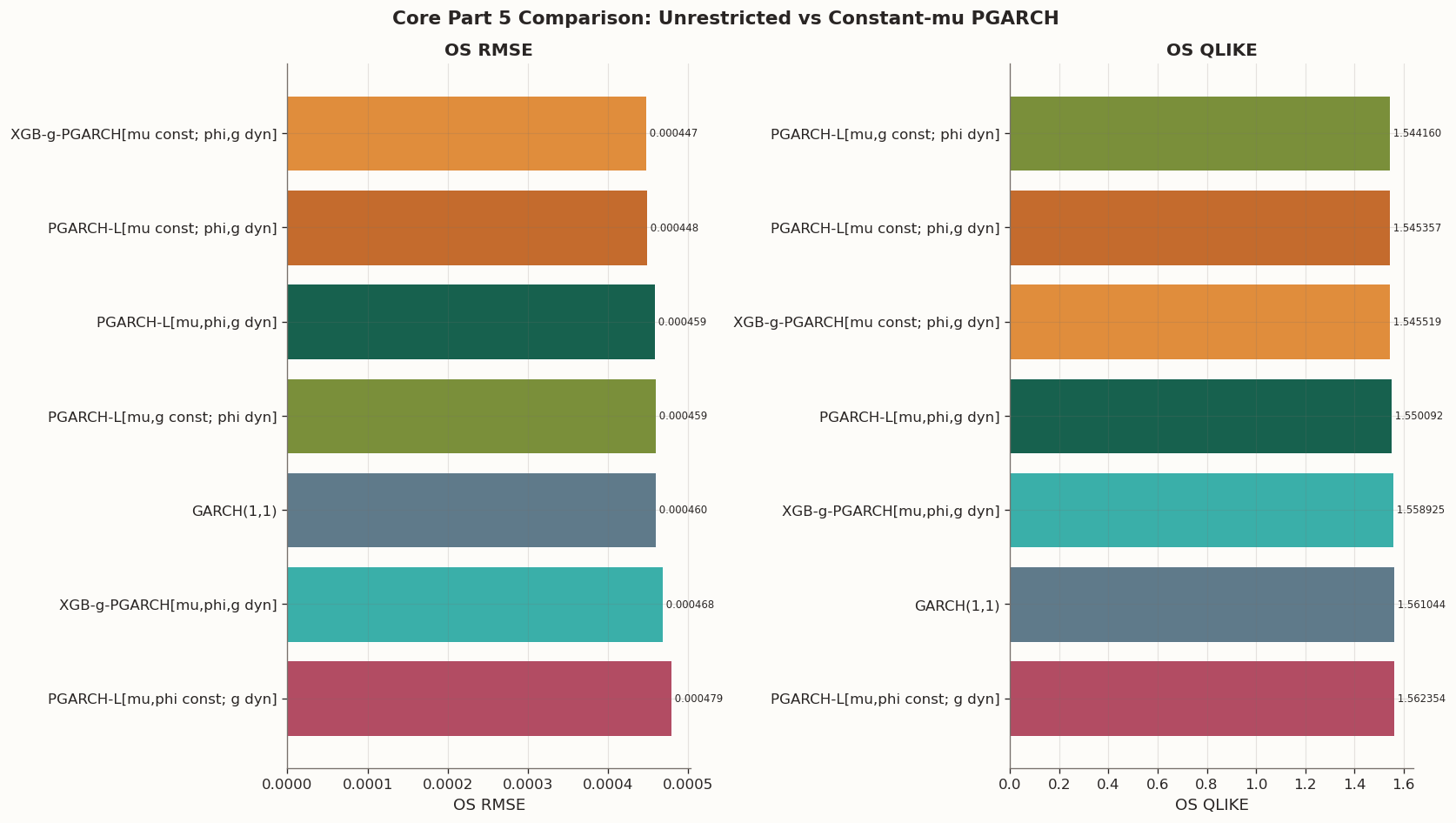
The constant-\mu family improves interpretability without requiring a forecasting sacrifice on this sample split. The constant-\mu linear model, PGARCH-L[mu const; phi,g dyn], improves mean out-of-sample QLIKE from 1.550 for the unrestricted linear model, PGARCH-L[mu,phi,g dyn], to 1.545, and it also improves RMSE from 0.000459 to 0.000448. The DM comparison against GARCH(1,1) remains directional rather than significant at conventional levels, so holding the long-run anchor fixed gives a cleaner specification while preserving benchmark-level forecast quality.

The constant-\mu boosted-g model, XGB-g-PGARCH[mu const; phi,g dyn], lands almost exactly on top of the constant-\mu linear model. This is expected and worth understanding precisely, because the same mechanism recurs in Part 6.

The gblinear booster can only add a linear correction to the g-channel raw scores, but the PGARCH-L initialiser has already found the approximately optimal linear map from the same three features to g. At that optimum the adjoint gradient with respect to g is near zero, so the booster has no signal to learn from. We verified this directly: even sweeping reg_lambda from 1.0 down to 0.001, the booster margin remains constant across all rows (zero feature-dependent variation). The residual gradient simply does not exist in the linear function class.

A separate but reinforcing mechanism is the small-Hessian problem documented in Part 3. The PGARCH recursion propagates second-order curvature through a chain of persistence factors \rho_t = \phi_t(1 - g_t), reducing per-row Hessians to O(10^{-5}) even after scaling returns by 100. The total Hessian across all training rows sums to approximately 0.09 — well below standard regularisation thresholds. We set reg_lambda = 0.01 rather than the default 1.0 to give the booster a fair chance; at \lambda = 1.0 the coordinate-descent denominator H_j + \lambda would be dominated by \lambda, masking the linear-on-linear identity behind a regularisation artefact. With \lambda = 0.01 the booster has every opportunity to learn, yet it finds nothing — confirming that the equivalence is structural, not an artefact of over-regularisation.

The equivalence would break only if the booster used a nonlinear learner (gbtree) or if a richer feature set left residual structure that the joint PGARCH-L optimisation did not fully resolve. Part 6 tests both of these directions. The unrestricted boosted-g model remains a useful comparison specification, but it is not the cleanest structural interpretation available under this information set.

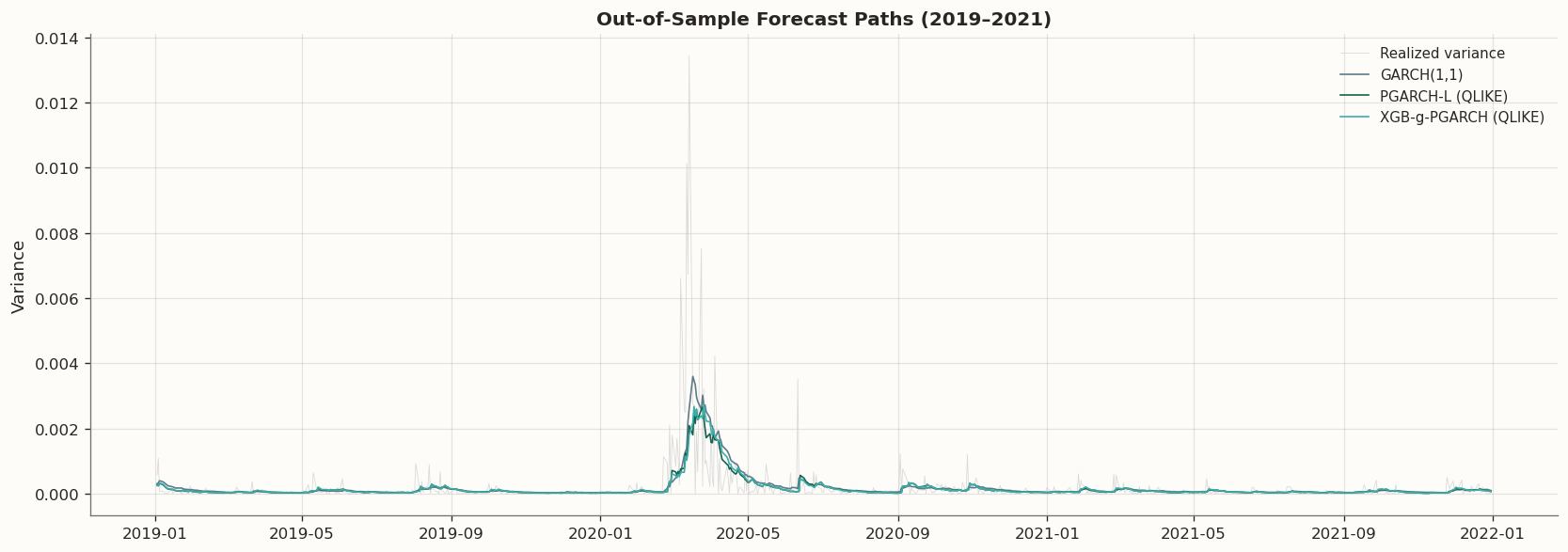
The diagnostic \phi-only restriction, PGARCH-L[mu,g const; phi dyn], gives the lowest mean QLIKE in this pass and outperforms GARCH(1,1) under the DM test on this split. This restriction was added only to locate where the useful adaptation appears after fixing \mu. Time-varying persistence appears to carry more of the useful variation than a dynamic long-run anchor does in this three-feature design.

Code
pairwise_specs = [
    ("PGARCH-L[mu const; phi,g dyn] vs PGARCH-L[mu,phi,g dyn]", core_model_predictions["PGARCH-L[mu const; phi,g dyn]"], core_model_predictions["PGARCH-L[mu,phi,g dyn]"]),
    (
        "XGB-g-PGARCH[mu const; phi,g dyn] vs XGB-g-PGARCH[mu,phi,g dyn]",
        core_model_predictions["XGB-g-PGARCH[mu const; phi,g dyn]"],
        core_model_predictions["XGB-g-PGARCH[mu,phi,g dyn]"],
    ),
    (
        "PGARCH-L[mu,phi const; g dyn] vs PGARCH-L[mu const; phi,g dyn]",
        core_model_predictions["PGARCH-L[mu,phi const; g dyn]"],
        core_model_predictions["PGARCH-L[mu const; phi,g dyn]"],
    ),
    (
        "PGARCH-L[mu,g const; phi dyn] vs PGARCH-L[mu const; phi,g dyn]",
        core_model_predictions["PGARCH-L[mu,g const; phi dyn]"],
        core_model_predictions["PGARCH-L[mu const; phi,g dyn]"],
    ),
]

pairwise_rows = []
for label, pred_a, pred_b in pairwise_specs:
    dm = diebold_mariano(_qlike_loss(actual_os, pred_a), _qlike_loss(actual_os, pred_b), h=1)
    pairwise_rows.append(
        {
            "Comparison": label,
            "OS QLIKE (A)": qlike(actual_os, pred_a),
            "OS QLIKE (B)": qlike(actual_os, pred_b),
            "DM (QLIKE)": dm["dm_stat"],
            "p-value": dm["p_value"],
        }
    )

pairwise_table = pd.DataFrame(pairwise_rows)
display(style_results_table(pairwise_table, precision=6, index_col="Comparison"))
Pairwise QLIKE comparisons among the unrestricted and constant-mu PGARCH variants
  OS QLIKE (A) OS QLIKE (B) DM (QLIKE) p-value
Comparison        
PGARCH-L[mu const; phi,g dyn] vs PGARCH-L[mu,phi,g dyn] 1.545357 1.550092 -0.221511 0.824717
XGB-g-PGARCH[mu const; phi,g dyn] vs XGB-g-PGARCH[mu,phi,g dyn] 1.545519 1.558925 -0.662636 0.507639
PGARCH-L[mu,phi const; g dyn] vs PGARCH-L[mu const; phi,g dyn] 1.562354 1.545357 1.860948 0.062896
PGARCH-L[mu,g const; phi dyn] vs PGARCH-L[mu const; phi,g dyn] 1.544160 1.545357 -0.122546 0.902478

The pairwise DM table shows that the constant-\mu linear model beats the unrestricted linear model directionally, but the improvement is small relative to sampling noise on this single split. The same is true when the unrestricted and constant-\mu boosted-g models are compared. Nevertheless, the constant-\mu extension is more interpretable than the unrestricted PGARCH-L, albeit not producing statistical gain against GARCH(1,1).

The more informative pairwise checks are the diagnostic restrictions inside the constant-\mu family. The g-only restriction, PGARCH-L[mu,phi const; g dyn], trails the constant-\mu linear model and sits close to the GARCH(1,1) benchmark, which suggests that a dynamic shock-loading channel on its own is not enough. By contrast, the \phi-only restriction, PGARCH-L[mu,g const; phi dyn], is essentially tied with the constant-\mu linear model. Taken together, those two comparisons point in the same direction: under the three return feature information set, most of the useful adaptation seems to come from time-varying persistence, while a separately dynamic g_t is secondary and a dynamic \mu_t is the least convincing channel structurally.

6 Diagnostics

The next table and plots compare how the unrestricted and constant-\mu linear PGARCH specifications allocate variation across the three channels on the test window. In the plot legends below, we shorten the labels to all dynamic, mu fixed, g dynamic only, and phi dynamic only. This is the direct check of whether the new family is actually more interpretable, rather than merely competitive in average loss.

Code
dates_os = X_te.index
linear_components_os = {}
structural_rows = []

for name, model in linear_structural_models.items():
    components = model.predict_components(X_pgarch_te.values)
    linear_components_os[name] = components
    structural_rows.append(
        {
            "Model": name,
            "mu mean": np.mean(components["mu"]),
            "mu std": np.std(components["mu"]),
            "phi mean": np.mean(components["phi"]),
            "phi std": np.std(components["phi"]),
            "g mean": np.mean(components["g"]),
            "g std": np.std(components["g"]),
        }
    )

structural_stats_table = pd.DataFrame(structural_rows)
display(style_results_table(structural_stats_table, precision=6, index_col="Model"))
Out-of-sample channel summaries for the linear PGARCH variants
  mu mean mu std phi mean phi std g mean g std
Model            
PGARCH-L[mu,phi,g dyn] 0.010790 0.226838 0.899862 0.034304 0.016483 0.013223
PGARCH-L[mu const; phi,g dyn] 0.002497 0.000000 0.996399 0.038024 0.120426 0.093304
PGARCH-L[mu,phi const; g dyn] 0.013379 0.000000 0.999860 0.000000 0.123143 0.058816
PGARCH-L[mu,g const; phi dyn] 0.000141 0.000000 0.983208 0.025070 0.115163 0.000000

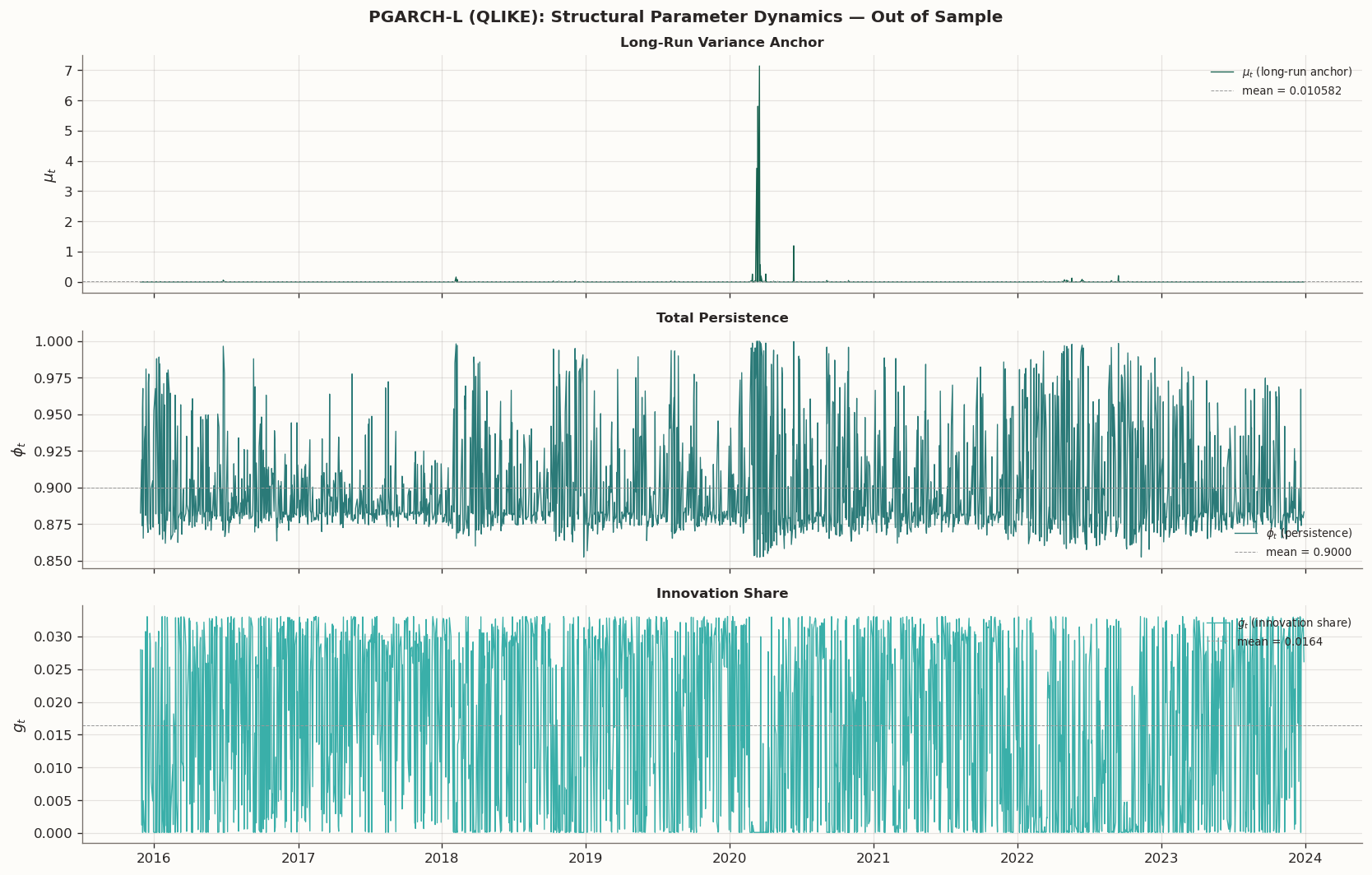
The unrestricted linear model assigns substantial variation to the long-run anchor: on the test window \mu_t ranges from essentially zero to several orders of magnitude above the fixed-anchor alternatives. That is hard to reconcile with the interpretation of \mu_t as a long-run variance level when the only inputs are recent return transforms.

Once \mu is fixed, the adjustment moves into \phi_t and, to a lesser extent, g_t. The near tie between the \phi-only restriction and the constant-\mu linear model, together with the weaker g-only restriction, suggests that persistence is doing most of the useful work here. We will see that more clearly in the charts below.

Compare the test-window channel paths for the unrestricted and constant-mu linear PGARCH variants
dyn = linear_components_os["PGARCH-L[mu,phi,g dyn]"]
constmu = linear_components_os["PGARCH-L[mu const; phi,g dyn]"]
g_only = linear_components_os["PGARCH-L[mu,phi const; g dyn]"]
phi_only = linear_components_os["PGARCH-L[mu,g const; phi dyn]"]

fig, axes = plt.subplots(3, 1, figsize=(14, 10), sharex=True)

axes[0].plot(dates_os, dyn["mu"], color="#17614E", linewidth=0.8, label="all dynamic")
axes[0].axhline(constmu["mu"][0], color="#C46B2D", linestyle="--", linewidth=1.0, label="mu fixed")
axes[0].axhline(phi_only["mu"][0], color="#7A8F3A", linestyle=":", linewidth=1.0, label="phi dynamic only")
axes[0].axhline(g_only["mu"][0], color="#B24C63", linestyle="-.", linewidth=1.0, label="g dynamic only")
axes[0].set_yscale("log")
axes[0].set_ylabel("mu")
axes[0].set_title("Long-Run Anchor", fontsize=10, fontweight="bold")
axes[0].legend(loc="upper right", fontsize=8)

axes[1].plot(dates_os, dyn["phi"], color="#17614E", linewidth=0.8, label="all dynamic")
axes[1].plot(dates_os, constmu["phi"], color="#C46B2D", linewidth=0.8, label="mu fixed")
axes[1].plot(dates_os, phi_only["phi"], color="#7A8F3A", linewidth=0.8, linestyle="--", label="phi dynamic only")
axes[1].set_ylabel("phi")
axes[1].set_title("Persistence", fontsize=10, fontweight="bold")
axes[1].legend(loc="lower right", fontsize=8)

axes[2].plot(dates_os, dyn["g"], color="#17614E", linewidth=0.8, label="all dynamic")
axes[2].plot(dates_os, constmu["g"], color="#C46B2D", linewidth=0.8, label="mu fixed")
axes[2].plot(dates_os, g_only["g"], color="#B24C63", linewidth=0.8, linestyle="--", label="g dynamic only")
axes[2].set_ylabel("g")
axes[2].set_title("Shock Loading", fontsize=10, fontweight="bold")
axes[2].legend(loc="upper right", fontsize=8)

fig.suptitle("Test-Window Channel Paths: Unrestricted vs Constant-mu PGARCH", fontsize=12, fontweight="bold")
fig.tight_layout()
plt.show()

Forecast paths around the COVID volatility spike
window_start = pd.Timestamp("2019-01-01", tz="UTC")
window_end = pd.Timestamp("2021-12-31", tz="UTC")
mask = (dates_os >= window_start) & (dates_os <= window_end)

fig, ax = plt.subplots(figsize=(14, 5))

ax.plot(dates_os[mask], actual_os[mask], color="#CCCCCC", linewidth=0.5, alpha=0.7, label="Realized variance")
ax.plot(dates_os[mask], core_model_predictions["GARCH(1,1)"][mask], color="#5F7A8A", linewidth=1.0, label="GARCH(1,1)")
ax.plot(dates_os[mask], core_model_predictions["PGARCH-L[mu,phi,g dyn]"][mask], color="#17614E", linewidth=1.0, label="all dynamic")
ax.plot(
    dates_os[mask],
    core_model_predictions["PGARCH-L[mu const; phi,g dyn]"][mask],
    color="#C46B2D",
    linewidth=1.0,
    label="mu fixed",
)
ax.plot(
    dates_os[mask],
    core_model_predictions["PGARCH-L[mu,g const; phi dyn]"][mask],
    color="#7A8F3A",
    linewidth=1.0,
    label="phi dynamic only",
)

ax.set_ylabel("Variance")
ax.set_title("Forecast Paths Around the COVID Volatility Spike (2019-2021)", fontsize=12, fontweight="bold")
ax.legend(loc="upper right", fontsize=9)
fig.tight_layout()
plt.show()

7 Conclusion

Drawing from our work in Part 4 where GARCH(1,1) has a lower QLIKE Loss than our STES-family models, we explore the structural advantage of GARCH and moves to generalize its parameters from a constant to other functional form, resulting in an unrestricted PGARCH model. However, we immediately see the problem with blindly applying our three return features to explain all the reparametrized GARCH parameters. Our return features are too fast to model the slow-moving dynamic of long-run variance level \mu. We therefore test imposing different restrictions on the PGARCH model. Within the constant-\mu family, the evidence points more toward time-varying persistence than toward time-varying shock loading alone.

The three-feature PGARCH idea remains promising. Several PGARCH variants match or beat GARCH(1,1) on mean out-of-sample QLIKE. With only lagged return, lagged absolute return, and lagged squared return available, a dynamic long-run anchor is not cleanly identified. The constant-\mu PGARCH variants therefore are the better formulation.

If the goal is a genuinely dynamic long-run channel, the information set has to change. Richer realized-volatility, calendar, or market-state features are needed before a time-varying \mu_t can be interpreted as more than a repackaging of recent shocks. Part 6 of this series is therefore motivated not by a need to discard the Part 5 PGARCH decomposition, but by the need to give its long-run channel a more credible set of predictors.

Stay tuned.

8 Appendix: PGARCH Derivative Details

This appendix collects the unrestricted PGARCH derivative formulas used in the model code. The constant-\mu and other channel-restricted variants in the main text are obtained by fixing the non-intercept feature coefficients of the corresponding channel at zero while retaining the intercept term, so no new derivative machinery is required.

8.1 Loss functions

We consider two training losses over the effective sample t = 1, \ldots, T-1 (excluding the warm-start h_0), with N = T-1:

MSE: L_{\text{MSE}} = \frac{1}{N}\sum_{t=1}^{T-1}(y_t - h_t)^2, \qquad u_t = \frac{2(h_t - y_t)}{N}, \qquad v_t = \frac{2}{N}

QLIKE: L_{\text{QLIKE}} = \frac{1}{N}\sum_{t=1}^{T-1}\left(\log h_t + \frac{y_t}{h_t}\right), \qquad u_t = \frac{1}{N}\left(\frac{1}{h_t} - \frac{y_t}{h_t^2}\right), \qquad v_t = \frac{1}{N}\left(-\frac{1}{h_t^2} + \frac{2y_t}{h_t^3}\right)

8.2 Jacobian recursion (Linear PGARCH)

Let \theta = [w_\mu, w_\phi, w_g] and \tilde{x}_{t-1} = [1, x_{t-1}]. Define block-embedded vectors d_t^\mu, d_t^\phi, d_t^g that place \tilde{x}_{t-1} in the appropriate block of \theta and zeros elsewhere.
The component Jacobians use the link derivatives:

J_t^\mu = \sigma(a_t) d_t^\mu, \qquad J_t^\phi = (\phi_{\max} - \phi_{\min}) s_b(1-s_b) d_t^\phi, \qquad J_t^g = (g_{\max} - g_{\min}) s_c(1-s_c) d_t^g

The intermediate quantity q_t = g_t y_{t-1} + (1-g_t)h_{t-1} has Jacobian

J_t^q = (1 - g_t) J_{t-1} + (y_{t-1} - h_{t-1}) J_t^g

The state Jacobian follows from h_t = (1-\phi_t)\mu_t + \phi_t q_t:

J_t = (1-\phi_t) J_t^\mu + (q_t - \mu_t) J_t^\phi + \phi_t J_t^q, \qquad J_0 = 0

8.3 Hessian recursion (Linear PGARCH)

The link Hessians are rank-one matrices:

H_t^\mu = s_a(1-s_a) d_t^\mu (d_t^\mu)^\top, \qquad H_t^\phi = (\phi_{\max}-\phi_{\min}) s_b(1-s_b)(1-2s_b) d_t^\phi (d_t^\phi)^\top

and similarly for H_t^g. The Hessian recursions are:

H_t^q = (1-g_t) H_{t-1} + (y_{t-1}-h_{t-1}) H_t^g - J_t^g J_{t-1}^\top - J_{t-1}(J_t^g)^\top

H_t = (1-\phi_t) H_t^\mu + (q_t-\mu_t) H_t^\phi + \phi_t H_t^q + J_t^\phi(J_t^q - J_t^\mu)^\top + (J_t^q - J_t^\mu)(J_t^\phi)^\top, \qquad H_0 = 0

8.4 Gradient and Hessian of the training loss

\nabla_\theta L = \sum_{t=1}^{T-1} u_t J_t, \qquad \nabla_\theta^2 L = \sum_{t=1}^{T-1}\left(v_t J_t J_t^\top + u_t H_t\right)

8.5 Boosted g-channel adjoint gradient (fixed \mu_t and \phi_t)

With \mu_t, \phi_t fixed and only c_t (the raw score for g_t) variable:

8.6 Boosted g-channel Hessian approximation (fixed \mu_t and \phi_t)

MSE (Gauss-Newton): H_s \approx \sum_{t=s+1}^{T-1} \frac{2}{N}\left(\frac{\partial h_t}{\partial c_s}\right)^2

QLIKE (Fisher-style): replace 2/N with w_t = \operatorname{clip}(1/(N h_t^2), \varepsilon, w_{\max}).

Both are computed efficiently via a backward accumulation:

F_{T-1} = w_{T-1}, \qquad F_t = w_t + \rho_t^2 F_{t+1}, \qquad H_s = \delta_s^2 F_{s+1}